Ghost Machines: What Enterprises Don't Know About the Automation Running Their Business

There is a particular kind of organizational blindness that develops slowly, almost imperceptibly, over years of digital transformation. A department automates a billing process here. A developer deploys a workflow bot there. An AI vendor quietly expands its footprint through a contract renewal nobody closely reviewed. And before long, the enterprise is operating a sprawling, undocumented ecosystem of intelligent systems that no single person—and often no single team—fully understands.
This is not a hypothetical scenario. According to technology governance consultants working with mid-to-large US enterprises, the majority of organizations with more than five years of active automation investment cannot produce an accurate, real-time inventory of every bot, AI model, robotic process automation (RPA) workflow, or machine learning pipeline currently running across their operations. The implications of that gap are more serious than most executive teams appreciate.
The Accumulation Problem
Automation sprawl doesn't happen through negligence alone. It happens because the incentives to deploy automation are strong and immediate, while the incentives to catalog and govern it are diffuse and delayed. A finance team that automates invoice reconciliation sees the benefit in days. The compliance officer who needs to audit that same automation for data handling practices won't surface the issue until something goes wrong—often years later.
This dynamic plays out across virtually every function in a large enterprise. HR deploys chatbots for benefits inquiries. Operations runs predictive maintenance models on manufacturing equipment. Marketing uses AI-driven personalization engines. IT maintains dozens of automated alert and remediation scripts. Each of these systems was presumably approved at some level, but the collective picture—who owns them, what data they touch, whether they're still performing as designed, and what they actually cost—rarely exists in any coherent form.
The result is what technology strategists have begun calling the "automation dark matter" problem: systems that exert real influence on business outcomes while remaining effectively invisible to governance structures.
What an Automation Audit Actually Involves
Forward-thinking US enterprises are increasingly treating the comprehensive automation audit as a strategic initiative rather than a housekeeping exercise. The scope is broader than most organizations initially anticipate.
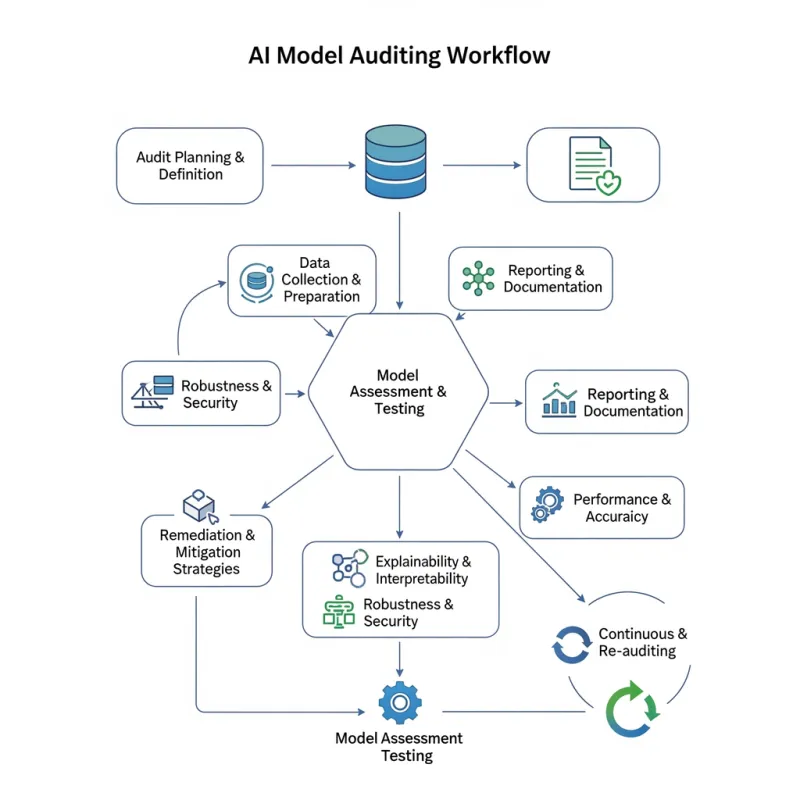
A rigorous audit begins with discovery—systematically identifying every automated system across the enterprise, from enterprise-licensed RPA platforms like UiPath or Automation Anywhere to custom scripts running on individual servers, to third-party AI services embedded in SaaS applications. This discovery phase alone frequently surfaces systems that IT leadership had no record of, often built by business units operating under shadow IT arrangements.
Once catalogued, each system requires classification. Is it still actively maintained? Does it have a designated owner? Is it connected to sensitive data—customer records, financial information, protected health information? Is it subject to regulatory requirements under frameworks like SOX, HIPAA, or state-level privacy laws such as the California Consumer Privacy Act? These questions are not bureaucratic formalities. Orphaned automation systems—those whose original developers have left the company or whose business context has changed—represent genuine legal and operational exposure.
The financial dimension of this work is equally significant. Licensing costs for enterprise automation platforms are substantial, and many organizations are paying for capacity they no longer use, or running redundant systems that perform overlapping functions across different departments. One technology governance firm working with a US financial services company recently identified more than $2.3 million in annual licensing waste stemming from duplicate automation deployments that had never been reconciled after a merger integration.
The Governance Framework That Prevents Recurrence
Discovering the current state of automation sprawl is only half the work. The more durable challenge is building governance structures that prevent the same accumulation from happening again.
Leading enterprises are establishing what some have termed an Automation Center of Excellence (CoE) with explicit responsibility for maintaining a living inventory of all deployed intelligent systems. This isn't simply a documentation exercise—it requires integrating automation governance into procurement workflows, project approval processes, and vendor contract reviews so that new deployments are catalogued before they go live rather than discovered years after the fact.
Role clarity is essential to making this work. Every automated system should have a named business owner accountable for its performance, compliance posture, and eventual decommissioning. Without that accountability structure, even well-intentioned governance frameworks tend to decay as organizational priorities shift and personnel turn over.
Some enterprises are also implementing technical controls to enforce governance at the infrastructure level—requiring that new automation deployments register with a central management platform before being granted access to production data environments. This approach shifts governance from a reactive audit function to a proactive architectural constraint.
The Compliance Dimension No One Wants to Discuss
Perhaps the most underappreciated risk embedded in unaudited automation portfolios is regulatory exposure. Automated systems that handle personal data, make decisions affecting customers or employees, or interact with financial reporting processes are increasingly subject to regulatory scrutiny—and regulators are not especially sympathetic to the argument that an organization didn't know a particular system existed.
The Federal Trade Commission has signaled growing interest in how AI and automated decision-making systems affect consumers. The SEC has issued guidance touching on algorithmic systems used in financial reporting contexts. And as AI-specific regulation continues to develop at both the federal and state level, enterprises with undocumented automation portfolios will find themselves unable to demonstrate the kind of systematic oversight that regulators are beginning to expect.
An automation audit conducted now, before regulatory pressure intensifies, positions the enterprise to respond credibly to compliance inquiries and to implement necessary controls while there is still time to do so deliberately rather than reactively.
Recovering Value From the Inventory
Beyond risk mitigation, there is a genuine value creation story embedded in the audit process. Enterprises that complete comprehensive automation inventories consistently discover opportunities to consolidate platforms, eliminate redundant processes, and redeploy automation capacity toward higher-priority use cases.
Orphaned workflows, once identified, can often be modernized rather than simply decommissioned—updated with current AI capabilities to deliver better performance than the original implementation. Systems that were built as point solutions for specific departmental problems frequently turn out to be applicable across the broader organization, allowing enterprises to amortize development costs across a wider base.
The audit also creates an accurate baseline for future automation investment planning. Enterprises that don't know what they have cannot make sound decisions about what they need next. A clear inventory transforms automation strategy from an exercise in aspiration to one grounded in operational reality.
The Urgency Is Now
The longer an enterprise waits to conduct a systematic audit of its automation assets, the more complex and costly that exercise becomes. Every quarter of additional deployment without governance adds to the inventory that will eventually need to be reconciled—and increases the probability that a compliance gap, security vulnerability, or operational failure will force the issue on an unfavorable timeline.
The enterprises taking automation governance seriously today are not doing so because they enjoy administrative rigor. They're doing it because they understand that intelligent automation, deployed at scale without systematic oversight, is not an asset. It is a liability disguised as progress. Knowing what you own is the first step toward actually controlling it.